The shelves are well stocked with supplements in health food shops, pharmacies, and even supermarkets. There are multivitamins, magnesium blends, collagen powders, green drinks, and, increasingly, products promising to improve your gut health. The message is hard to miss: if you want to be healthier, you probably need a little something extra.
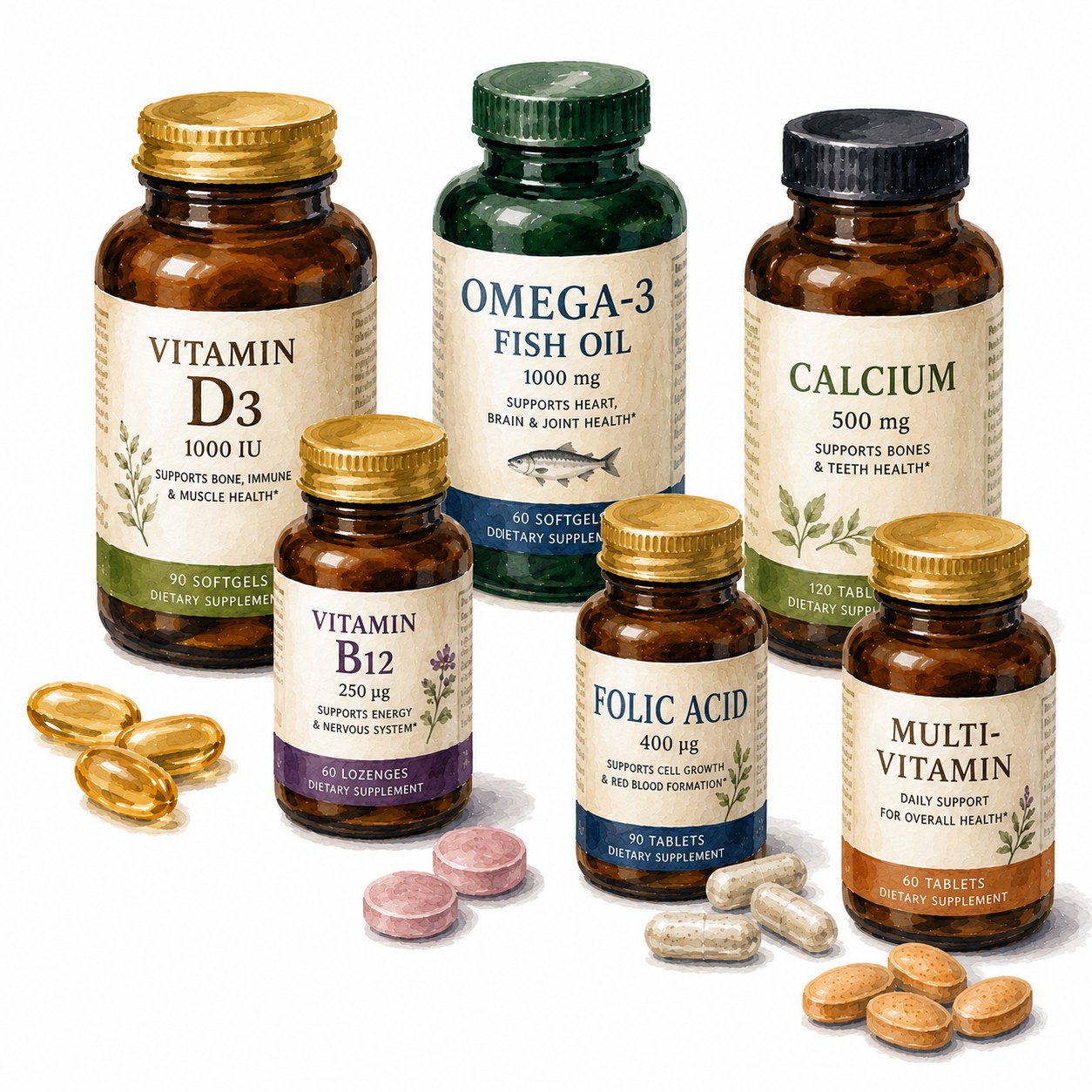
That message has clearly landed. Around 74% of US adults take supplements, and the number of products on the market grew from roughly 4,000 in 1994 to more than 55,000 by 2012 (Geller et al., 2015; Starek et al., 2026). People’s reasons are revealing. The most common motivation is to improve general health rather than to correct a diagnosed deficiency, and only around 23% of supplements are taken on the advice of a doctor or other health professional (Bailey et al., 2013). Marketing has evolved alongside, moving from pharmacy shelves to social media feeds, where a recommendation often looks more like friendly advice than an advert. But do the science and the hype tell the same story, or are we simply being sold hope?
Where the evidence is strong
Some supplements have solid evidence behind them. Folic acid in early pregnancy is the clearest example. Trials established that it prevents most neural tube defects, the serious malformations of the brain and spine that include spina bifida. The NHS advises 400 micrograms daily, ideally from three months before conception through the first twelve weeks (NHS, 2026), and gives a specific reason for supplementing rather than simply eating better: the amount needed is difficult to obtain from food alone.
The recommendation is well founded and, notably, narrow. The same logic covers the other strong cases. The NHS advises 10 micrograms of vitamin D daily from October to March, because UK sunlight is too weak then for skin to make enough, and year-round for people who cover their skin, stay mostly indoors, or have darker skin (NHS, 2026). Iron corrects diagnosed iron deficiency anaemia, and vitamin B12 treats pernicious anaemia, where the body cannot absorb it from food. What follows is not an argument that supplements never work, but that the evidence narrows sharply the moment you step outside a diagnosed deficiency.
The vitamin D halo
Vitamin D illustrates that narrowing, because it is also the supplement most heavily promoted for benefits far beyond bone health. Researchers at the University of Edinburgh pooled several hundred reviews of vitamin D and dozens of health outcomes, checking observational findings against trials wherever both existed (Theodoratou et al., 2014). They found no outcome where the evidence was convincing in both. The familiar claims about heart disease, depression, cognition, diabetes, and cancer were too inconsistent or too weak. More striking was the negative finding: no support for vitamin D alone improving bone density or reducing fractures and falls in older adults, the very thing most people assume it reliably does.
Where the evidence is weak
Trouble starts when a supplement is sold not as treatment for a deficiency but as a general upgrade for people who are already adequately fed, which is how most are sold. Multivitamins are the best studied case, and trials have consistently found no effect on death from any cause (Macpherson et al., 2013; Neves et al., 2026). The largest recent test followed 390,124 healthy US adults for up to 27 years (Loftfield et al., 2024). It was designed to strip out two biases: healthy people are more likely to take multivitamins, and unwell people often start taking them in hope. With both accounted for, daily use showed no reduction in deaths from any cause, heart disease, or cancer. For a healthy, well-nourished adult, the daily multivitamin is not buying the benefit the marketing implies.
The pattern holds more broadly. A review of 62 umbrella reviews found that only about a quarter of findings supported a supplement working on moderate to high certainty evidence; most positive-sounding results rested on weak evidence (Piragine et al., 2025). Probiotics and gut health raise the same questions in a more tangled form, and are the subject of a separate article.
Why a capsule is not a carrot
Diets rich in carotenoid-containing fruit and vegetables were consistently linked to lower lung cancer risk, which is why 29,133 Finnish male smokers were given 20 mg of beta-carotene daily for five to eight years. Lung cancer incidence rose by 18% and overall mortality by 8% (Alpha-Tocopherol, Beta Carotene Cancer Prevention Study Group, 1994). A US trial giving beta-carotene with vitamin A to smokers and asbestos workers was halted early for the same reason (Omenn et al., 1996).
Nothing about eating vegetables does this, and the difference is mostly dose. Food delivers nutrients at modest concentrations, bound up with fibre and everything else in the plant, and appetite stops you long before a pharmacological dose is anywhere in reach. A capsule removes every one of those brakes. It takes seconds to swallow what would take a great deal of eating, and several products can stack the same nutrient without the person noticing. Overdoing supplements is easy. Overdoing broccoli is not.
The UK picture
UK-specific evidence is sparse compared with the US. The most relevant assessment is an umbrella review in the Annals of Internal Medicine, pooling 277 trials across nearly a million people, including ASCEND, a large Oxford-run trial of omega-3 in UK adults with diabetes (Khan et al., 2019). Most supplements, including multivitamins, antioxidants, iron, and vitamins A, B, C, D, and E, showed no effect on deaths, heart attacks, or strokes. The clearest benefit came not from a supplement at all but from eating less salt. Omega-3 modestly reduced heart attacks on weaker evidence, and folic acid was linked to lower stroke risk, though largely on one trial in a population without folate-fortified flour, so it may not apply here. The one sign of harm was that calcium and vitamin D together were linked to slightly raised stroke risk.
That matters, because supplement use rises steeply with age and much of it is not self-directed. UK guidance recommends year-round vitamin D for people who are housebound or in care homes, and osteoporosis treatment pairs bone drugs with calcium and vitamin D.
Which makes the newest evidence uncomfortable. A 2026 BMJ review pooled 69 trials and 153,902 participants and found that calcium, vitamin D, or the two combined had little to no clinically meaningful effect on fractures or falls (Massé et al., 2026). Combined supplementation did reduce fractures in statistical terms, but the difference was around one percentage point, below the level the authors had set in advance as clinically important. Their trials excluded people already taking osteoporosis drugs, and evidence remains thin for those at very high risk or in care. Even so, bone protection is the commonest reason older adults take these supplements, and it now has less behind it than almost any other claim.
Who funds the research
Industry funding does not automatically invalidate a study, and much good science is funded that way out of necessity. But the effect is measurable. Lesser et al. (2007) examined 206 nutrition studies on soft drinks, juice, and milk, with one team rating each conclusion as favourable or not and a separate, blinded team recording the funding. Among industry-funded trials, not one reached an unfavourable conclusion, against 37% of those with no industry funding.
Outright fraud is rarely the mechanism. Sponsors fund studies they expect to go well, investigators frame questions in ways a sponsor will like, and inconvenient results quietly go unpublished.
Most bias in science eventually cancels itself out. A researcher attached to a pet theory will sooner or later meet a rival who can make their name proving it wrong, so the pressures push in opposite directions. Money does not work that way. Everyone funded by the same industry is nudged in the same direction, so the errors keep piling up instead of cancelling out.
The marketing layer
Supplements are regulated far more loosely than medicines. In the UK they fall under food law, so selling something unsafe or falsely described is a criminal offence, but nothing requires a manufacturer to show that a product works before selling it (Starek et al., 2026). The US treats them the same way, as a class of food the FDA does not approve for either safety or effectiveness.
The consequences show up in the products, and fish oil is the sharpest example, because omega-3 fats oxidise readily. When researchers at the University of Auckland tested every encapsulated fish oil supplement on sale in New Zealand, only three of 32 contained as much EPA and DHA as the label claimed, and most held less than two-thirds of it. Most were also rancid: 83% exceeded recommended peroxide levels, and just 8% met all the international thresholds (Albert et al., 2015). Most fish oil sold worldwide comes from the same South American fishery, so the authors expect wider relevance. Nothing on the packaging helped, as best-before date, price and country of origin were all useless as guides to quality. More troubling still, trials of fish oil have never reported the oxidative state of the oil they used, so some of the disappointing results may reflect the product rather than the nutrient.
Marketing operates in the space that regulation leaves. Starek et al. point to umbrella branding, where a company launches a medicine under one brand and then a supplement under a near-identical one, so the supplement borrows credibility it has not earned. Influencer marketing does similar work, and adolescents are the most exposed. Supplement use among children and teenagers has climbed over recent decades, most often driven by a wish to change how they look or how they perform in sport, and taken without medical supervision it carries real risks of overdose and interaction with medicines (Barretto et al., 2024).
The bottom line
Three questions will usually tell you what you need to know when someone recommends a supplement. Do they sell what they recommend, earn commissions, or accept sponsorship? Do they cite high-quality randomised controlled trials, or simply gesture towards “studies” without explaining what they found? Do they distinguish between correcting a deficiency and improving the health of someone who is already well nourished, or blur the two because the latter is a much bigger market?
Failing to find a benefit is not the same as finding a harm. For most multivitamins, the evidence suggests they do very little, not that they are dangerous. The greatest cost is often opportunity cost: money and attention spent chasing marginal gains from capsules when the strongest evidence still supports eating a healthy dietary pattern. In the UK, the more likely mistake is skipping the winter vitamin D than taking one capsule too many. The hype is the promise of a general upgrade. The hope worth keeping is less glamorous but far better supported by the evidence: eat a healthy diet rich in whole foods and lower in salt, be physically active, prioritise sleep, and take supplements when there is a genuine need, not because of clever marketing. The best health investments are often the least marketable. They don’t come in a bottle, they can’t be patented, and they’re more likely to be found in the fruit and vegetable aisle than the supplement aisle.
References
Albert, B. B., Derraik, J. G. B., Cameron-Smith, D., Hofman, P. L., Tumanov, S., Villas-Boas, S. G., Garg, M. L., & Cutfield, W. S. (2015). Fish oil supplements in New Zealand are highly oxidised and do not meet label content of n-3 PUFA. Scientific Reports, 5, 7928. https://doi.org/10.1038/srep07928
Alpha-Tocopherol, Beta Carotene Cancer Prevention Study Group. (1994). The effect of vitamin E and beta carotene on the incidence of lung cancer and other cancers in male smokers. New England Journal of Medicine, 330(15), 1029–1035. https://doi.org/10.1056/NEJM199404143301501
Bailey, R. L., Gahche, J. J., Miller, P. E., Thomas, P. R., & Dwyer, J. T. (2013). Why US adults use dietary supplements. JAMA Internal Medicine, 173(5), 355–361. https://doi.org/10.1001/jamainternmed.2013.2299
Barretto, J. R., Gouveia, M. A. da C., & Alves, C. (2024). Use of dietary supplements by children and adolescents. Jornal de Pediatria, 100(Suppl 1), S31–S39. https://doi.org/10.1016/j.jped.2023.09.008
Geller, A. I., Shehab, N., Weidle, N. J., Lovegrove, M. C., Wolpert, B. J., Timbo, B. B., Mozersky, R. P., & Budnitz, D. S. (2015). Emergency department visits for adverse events related to dietary supplements. New England Journal of Medicine, 373(16), 1531–1540. https://doi.org/10.1056/NEJMsa1504267
Khan, S. U., Khan, M. U., Riaz, H., Valavoor, S., Zhao, D., Vaughan, L., Okunrintemi, V., Riaz, I. B., Khan, M. S., Kaluski, E., Murad, M. H., Blaha, M. J., Guallar, E., & Michos, E. D. (2019). Effects of nutritional supplements and dietary interventions on cardiovascular outcomes: An umbrella review and evidence map. Annals of Internal Medicine, 171(3), 190–198. https://doi.org/10.7326/M19-0341
Lesser, L. I., Ebbeling, C. B., Goozner, M., Wypij, D., & Ludwig, D. S. (2007). Relationship between funding source and conclusion among nutrition-related scientific articles. PLoS Medicine, 4(1), e5. https://doi.org/10.1371/journal.pmed.0040005
Loftfield, E., O’Connell, C. P., Abnet, C. C., Graubard, B. I., Liao, L. M., Beane Freeman, L. E., Hofmann, J. N., Freedman, N. D., & Sinha, R. (2024). Multivitamin use and mortality risk in 3 prospective US cohorts. JAMA Network Open, 7(6), e2418729. https://doi.org/10.1001/jamanetworkopen.2024.18729
Macpherson, H., Pipingas, A., & Pase, M. P. (2013). Multivitamin-multimineral supplementation and mortality: A meta-analysis of randomized controlled trials. American Journal of Clinical Nutrition, 97(2), 437–444. https://doi.org/10.3945/ajcn.112.049304
Massé, O., Mercurio, C. M., Dupuis, S., Al Sahwi, M., Arruda, A., Dallaire, G., Desforges, K., Dugré, N., & Williamson, D. (2026). Calcium, vitamin D, or combined supplementation to prevent fractures and falls: Systematic review and meta-analysis. BMJ, 393, e088050. https://doi.org/10.1136/bmj-2025-088050
Neves, P. M., Almeida, S., & Domingues, V. (2026). Multivitamins in adult medical practice: Evidence, risks, and pragmatic prescribing. Cureus, 18(1), e101985. https://doi.org/10.7759/cureus.101985
NHS. (2026). Pregnancy vitamins and supplements. https://www.nhs.uk/pregnancy/keeping-well/pregnancy-vitamins-and-supplements/
Omenn, G. S., Goodman, G. E., Thornquist, M. D., Balmes, J., Cullen, M. R., Glass, A., Keogh, J. P., Meyskens, F. L., Valanis, B., Williams, J. H., Barnhart, S., & Hammar, S. (1996). Effects of a combination of beta carotene and vitamin A on lung cancer and cardiovascular disease. New England Journal of Medicine, 334(18), 1150–1155. https://doi.org/10.1056/NEJM199605023341802
Piragine, E., Malanima, M. A., Calderone, V., De Masi, S., Ghelardini, C., Mugelli, A., & Lucenteforte, E. (2025). Dietary supplements for human health. What do we really know? A systematic review of umbrella reviews. Annali dell’Istituto Superiore di Sanità, 61(3), 163–172. https://doi.org/10.4415/ANN_25_03_02
Starek, M., Błasiak, M., & Dąbrowska, M. (2026). Insights into dietary supplements as popular product supporting the diet. Naunyn-Schmiedeberg’s Archives of Pharmacology, 399(6), 7711–7725. https://doi.org/10.1007/s00210-025-04889-z
Theodoratou, E., Tzoulaki, I., Zgaga, L., & Ioannidis, J. P. A. (2014). Vitamin D and multiple health outcomes: Umbrella review of systematic reviews and meta-analyses of observational studies and randomised trials. BMJ, 348, g2035. https://doi.org/10.1136/bmj.g2035